
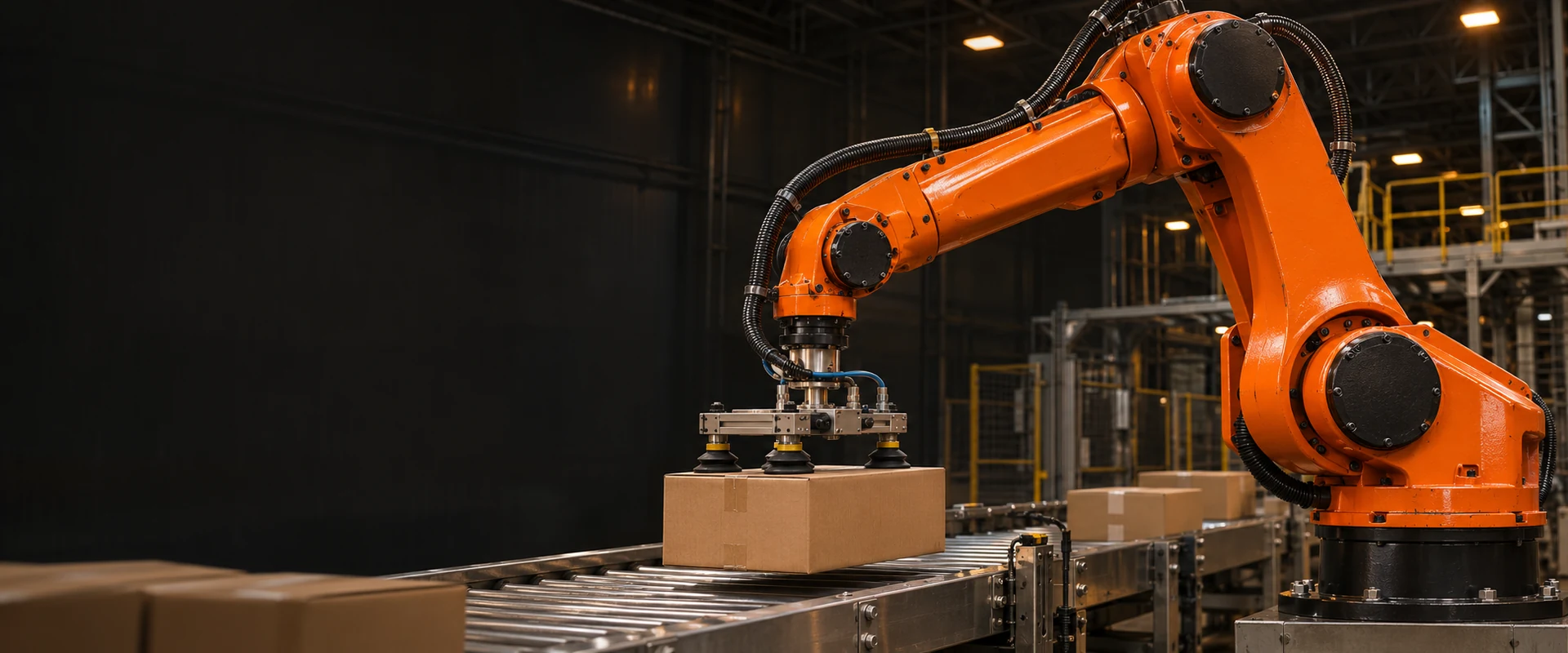
Industrial robotics
for Ontario plants.
We believe robotics and AI can improve every stage of production. Start with one task and measure what changes.
Inside the
palletizing cell.
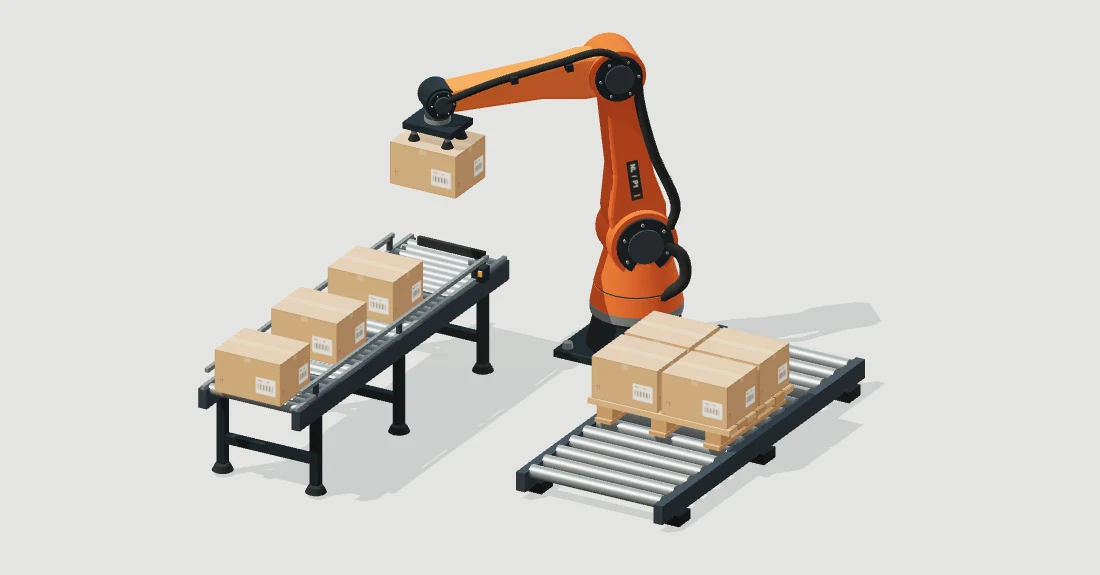
Follow a sealed case from the infeed conveyor onto the pallet. Explore the layout from three angles.
Cell layout
Trace the path from the roller conveyor to the pallet. Measure the space for replenishment, maintenance access and the finished load.
Compare a published equipment specification
Robotiq’s PE20 manual lists up to 20 kg payload excluding the gripper, up to 13 cycles per minute and a maximum filled pallet height of 2,150 mm for the documented configuration. Tooling, case size and stack pattern affect what a line can sustain. Request a timed test of your actual mix. PE20 manual, table 6-1
A food plant in practice.
Robotiq reports these results for Glenhaven, an Irish frozen-food manufacturer.
- Reported throughput
- 15 boxes/min
- Product variety
- 25 SKUs
- Reported payback
- 13 months
Site-specific results. Verify your own product mix, changeovers and costs in a trial. Read Robotiq’s Glenhaven case study
Delivery.
What to scope, test and hand over before a robot joins the shift.
Feasibility
Start with actual cases, peak flow, pallet patterns and space. A feasibility study defines the layout options, exclusions and payback inputs your plant can verify.
Integration
Define who supplies the arm, gripper, controls and guarding. Agree on representative products, factory and site acceptance tests, operator training and the commissioning window with a qualified integration partner.
Lifecycle support
Set ownership for maintenance, spare parts and fault recovery before handover. Agree on response coverage and change procedures for new cases, shifts or lines.
Plan a shift.
Use a running rate and the share of scheduled time the line actually runs. The result estimates case demand for a cell proposal.
60 full pallets · 0 cases left over
Payback calculator.
Use your own costs and the annual benefit your plant can realize. All inputs are in US dollars.
How the estimate works
Months = installed cost ÷ (annual gross benefit − annual support cost) × 12. Include avoidable overtime or realizable throughput gains once. The starting figures are illustrative. Financing, taxes, downtime and the time value of money are excluded.
Build a
line brief.
Capture the facts a plant engineer needs for a first feasibility conversation.